
Building a Keyword Intelligence System for a Footwear Ecommerce Brand
A shoe brand with 180+ active SKUs across five categories had almost no non-branded organic search coverage. Manual keyword research was the bottleneck. Here's the system we built to solve it.
Active SKUs across 5 footwear categories
Revenue growth in Year 1
Per-product research time, down from 5–10 hours
Full catalog coverage, down from 9–12 months
The Opportunity
Organic search captures buyers at the point of purchase, before they reach a competitor. Footwear is one of the highest return categories for it. When a buyer searches "waterproof hiking boots men under $150" or "wide-width dress shoes with memory foam insoles," they have already defined their need, their use case, and in many cases their budget. These queries convert at a materially higher rate than broad paid audiences and they don't require ongoing ad spend to maintain.
The client, a footwear ecommerce brand doing approximately $12M in annual revenue, had a catalog of 180+ active SKUs across five categories: trail running, casual and lifestyle, dress and formal, work and safety, and outdoor and hiking. Their paid search program was profitable on branded terms. Their organic search presence was almost entirely absent on non-branded queries. Competitors, including larger national retailers and specialty footwear sites, were ranking for the long-tail queries this brand's products were built to serve.
The brand's marketing team understood the organic opportunity. The constraint was research capacity. Their SEO-focused team member could cover roughly 15–20 products per month working manually. At that pace, achieving full catalog coverage would take 9–12 months, and the catalog was growing, not static. The research bottleneck wasn't a strategy problem. It was a systems problem.
Why Footwear Research Is Particularly Time-Intensive
Footwear keyword research is more complex than most product categories. A single SKU like a waterproof trail running shoe requires a full research workflow before a single piece of content can be scoped:
Seed keyword generation
Starting with the product's core terms and expanding to category variations, product attributes, buyer segments, and use-case framing specific to footwear.
Search volume analysis
Validating which queries carry meaningful traffic potential before any content investment is made.
SERP analysis
Assessing competitive difficulty and identifying ranking opportunities based on the current composition of search results for each query.
Intent classification
Mapping each keyword to its buyer stage: informational, commercial, or transactional. A trail running buying guide and a product page target different stages and require different formats.
Keyword clustering
Grouping related queries into content clusters, each mapping to a single page or asset. This determines the content plan, not just the keyword list.
Prioritization
Scoring clusters by opportunity value weighted against content investment. High-margin, low-competition clusters with clear buyer intent get resourced first.
Across five categories and 180+ SKUs, a manual research process produces one of two outcomes: either a small fraction of the catalog gets deep keyword coverage, or every product gets shallow coverage that misses the most valuable long-tail queries. Neither outcome builds a durable organic traffic asset.
The research bottleneck had to be eliminated before any content program could operate at the scale the catalog required.
The Solution
We built a Keyword Intelligence System as a research tool configured specifically for the client's footwear catalog. The system compresses the entire per-product research workflow into three stages, replacing the manual, tool-dependent process with structured automation that understands footwear-specific buyer intent, category architecture, and content formats.
Rather than applying a generic keyword methodology, the system was configured with the client's category taxonomy (trail running, casual/lifestyle, dress/formal, work/safety, outdoor/hiking), their key product attributes (fit, material, waterproofing, price tier, intended use), and their margin priorities. The output reflects how their buyers actually search scored by business impact.
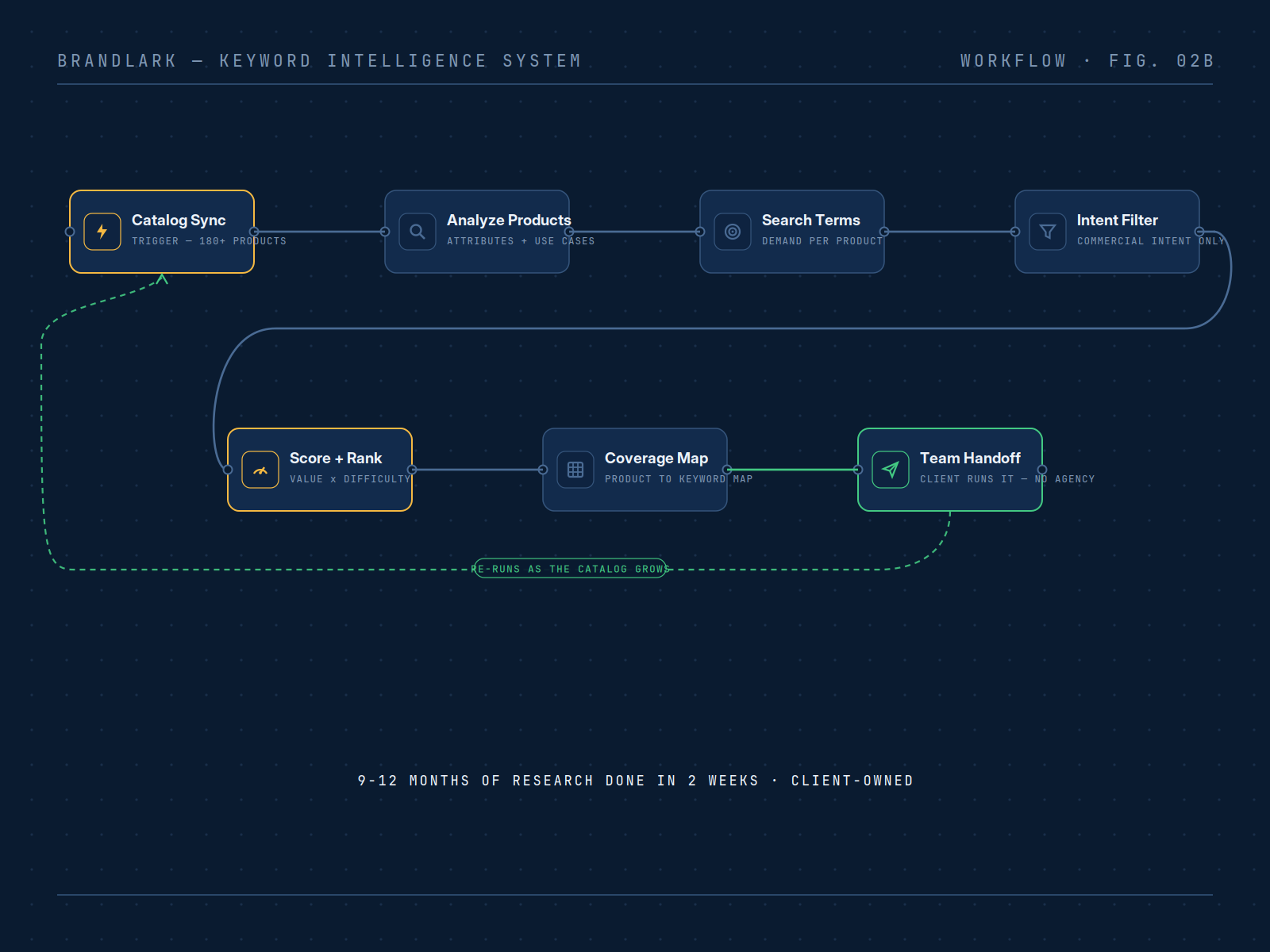
Stage 1: Product Input and Context Mapping
The researcher inputs the product name, category, price point, and target customer. For a footwear SKU, this includes fit attributes (standard, wide, narrow), material (leather, mesh, waterproof membrane), intended use case (trail running, work, dress), and price tier. The system generates a structured context map: buyer segments, use-case framing, key differentiators, and semantic variations specific to how footwear buyers search. This replaces the manual brainstorming phase and ensures no query angle (fit, use case, persona, comparison, or price) is missed.

Stage 2: Keyword Expansion and Scoring
From the context map, the system generates a full keyword set: head terms, long-tail variants, question-based queries, comparison queries, and buyer-persona queries. For a waterproof trail running shoe, this surfaces clusters like "waterproof trail running shoes wide width," "best trail shoes for rain hiking," and "trail running shoes vs hiking shoes waterproof." These are queries a time-constrained manual process would never reach. Each keyword is scored by a composite metric weighting search volume, estimated competition, and commercial intent. Output is ranked by opportunity value, not raw volume.

Stage 3: Content Cluster Output
Keywords are grouped into content clusters by topic and intent. For a footwear SKU, clusters typically include: product page optimization (transactional head terms), a buying guide (informational/commercial intent), a comparison article (decision-stage queries), and an FAQ cluster (question-based long-tail). Each cluster maps to a recommended content format with the target keyword set, intent classification, and competitive notes. Output is a structured brief ready for AirOps, a GPT pipeline, or a human writer with no reformatting step required.

Connecting to Content Generation
The cluster brief output integrates directly with AirOps workflow templates configured for footwear content. Each cluster, whether a buying guide for waterproof trail shoes, a comparison article for work boot alternatives, or an FAQ page for wide-width dress shoes, becomes a content task with structured inputs: target keywords, intent, recommended format, product context, and competitive framing. No manual reformatting. A researcher runs the tool, AirOps picks up the output, and a draft is in review within hours.
AirOps integration
The cluster output feeds directly into AirOps workflow templates. Each keyword cluster becomes a content task with structured inputs with no manual reformatting and no brief-writing overhead. For the footwear client, this meant a single workflow ran across trail running, work/safety, and dress categories simultaneously.
Custom GPT pipelines
The JSON output passes directly to GPT-4-class models configured with footwear-specific content prompts. Product context, keyword cluster, intent type, and format recommendation are all present. The model produces content optimized for the target queries, not generic product descriptions that ignore how footwear buyers search.
Human writer handoff
For content requiring editorial judgment, including comparison articles and in-depth buying guides, the cluster brief serves as a complete writer brief. Writers receive keyword targets, intent classification, recommended format, and competitive context. For footwear, this meant writers understood not just the keyword set but the buyer persona behind each cluster: the weekend hiker, the wide-footed professional, the nurse on a 12-hour shift.
A System the Client Owns
The Keyword Intelligence System was deployed as client infrastructure, not a vendor subscription. This distinction matters structurally: the client's team runs the tool, the configuration reflects their category logic, and there is no dependency on a third-party SaaS platform that can change pricing, restrict features, or be cancelled.
No recurring software fees
There is no per-seat subscription, no monthly platform fee, and no usage-based billing. For a footwear brand previously paying $200–$500/month per researcher seat across Ahrefs, Semrush, or similar tools, this represents a direct and permanent reduction in tooling overhead.
Built around footwear-specific logic
The system was configured with the client's category taxonomy, product attributes, and margin priorities, not a generic keyword scoring algorithm. It knows the difference between a trail running query and a hiking query. It understands that wide-width and waterproof are high-value modifiers for this brand, not noise. Off-the-shelf tools don't know any of this.
Operated by the client's team
Once deployed, the client's marketing manager runs the tool independently. There's no account manager to call, no vendor to depend on, and no risk of a platform change disrupting the workflow. As the catalog grows or the category mix shifts, the system configuration is updated internally. It is infrastructure the brand controls.
The Impact
Before the Keyword Intelligence System, the client's SEO team was covering 15–20 products per month. At that pace, full catalog coverage would have taken the better part of a year, excluding every long-tail query that took more than a few minutes to surface. With the system in place, the same team researcher achieved full catalog coverage across all 180+ SKUs in under two weeks.
| Before | With Keyword Assistant | |
|---|---|---|
| Research time per SKU | 5–10 hours | ~5 minutes |
| Revenue growth (Year 1) | Baseline | +8% |
| SKUs covered per week (1 FTE) | 4–5 products | 50–100 products |
| Full catalog coverage | 9–12 months | Under 2 weeks |
| Long-tail query coverage | Incomplete, time-constrained | Systematic across all fit, use-case, and persona variants |
| Footwear-specific logic | Researcher-dependent, inconsistent | Configured and consistent across categories |
| Content brief format | Unstructured spreadsheet | Structured clusters, AirOps-ready |
| Monthly tooling cost | $200–$500/seat (SaaS tools) | Negligible compute cost |
| System ownership | Vendor-dependent | Client-owned, team-operated |
The Long-Tail Advantage in Footwear
Footwear long-tail queries like "slip-resistant work shoes for nurses wide width," "best waterproof hiking boots for women with plantar fasciitis," and "trail running shoes for heavy overpronators" are the highest-converting queries in the category. They're also the ones a time-constrained manual process never reaches. The Keyword Assistant surfaces them systematically. The brands that rank for these queries don't spend more on research. They have a better research process.
The Keyword Intelligence System is one component of how Brandlark builds Demand Ownership for ecommerce brands: the systematic capture of non-branded, high-intent organic search traffic across the full product catalog. For this footwear client, full catalog coverage created the foundation for a content program that could operate at category scale, including trail running buying guides, comparison content for work and safety footwear, and fit and specification content targeting the wide-width and specialty-fit buyer segments that no competitor was serving with quality content.
A fully-covered keyword catalog with quality content reduces paid acquisition dependency, improves blended CAC, and builds a durable traffic asset that grows in value over time. For a $12M footwear brand running 80% of its customer acquisition through paid channels, the organic opportunity mapped by the system represented a meaningful reallocation of marketing capital.
We use Growth Capital Efficiency (GCE) to prioritize which footwear categories and keyword clusters get resourced first. Trail running and work/safety were the highest-GCE categories for this client, given their margin profile and the competitive gap in organic coverage.