
Building a Bundle Logic System to Lift AOV Without Discounting Margin
A home goods brand converting well but leaving revenue on the table with every single-item checkout. Here's the bundle engine we built to lift average order value by 28% and generate $800K in projected incremental annual revenue — without blanket discounts.
Lift in average order value within 6 weeks
Bundle attach rate across eligible product pages
Projected incremental annual revenue from AOV lift
From system build to full catalog deployment
The Opportunity
Most ecommerce brands focus their growth effort on acquiring more customers. But there's a simpler math: if every existing customer bought one more item per order, revenue would increase without any additional ad spend. When a store sells products that naturally go together, getting customers to spend more per order is one of the biggest growth opportunities. Yet most brands don't have a system to make it happen.
The client, a home goods ecommerce brand doing approximately $6M in annual revenue, had a catalog of 200+ SKUs across cookware, kitchen tools, storage, and home organization. Their conversion rate was healthy — 3.1% on desktop, 2.4% on mobile. Their average order value was $67. The problem was that 74% of orders contained a single item. Customers were finding what they came for and leaving, even when the catalog contained products they were likely to need and would have bought if prompted correctly.
The team had attempted bundles before with a "buy more, save more" banner on the homepage and a few manually curated product sets. Neither produced meaningful results. The banner was generic and untargeted. The product sets were built on intuition rather than purchase data. The opportunity wasn't the concept. It was the absence of a system built around how customers actually shop.
Why Home Goods Has Structural AOV Potential That Goes Uncaptured
Home goods and kitchenware have category-specific characteristics that make bundle logic particularly high-return when implemented correctly:
Natural purchase affinity across SKUs
Customers buying a cast iron skillet frequently need a compatible lid, a silicone handle cover, or a seasoning oil. These are not upsells — they are functionally related purchases the customer will make eventually, likely from a competitor. The question is whether the bundle logic surfaces them at the right moment.
Replenishment and consumable complement patterns
Categories like cleaning supplies, storage bags, and paper goods have predictable replenishment cycles. A customer buying a storage system is likely to buy organization accessories within 30 days. Capturing that purchase at the initial transaction avoids the cost of a second acquisition touchpoint.
Low single-item utility relative to the full system
Many home goods products deliver more value as part of a set. A single mixing bowl has less perceived value than a nested bowl set. A single shelf bracket needs a shelf. Customers understand this — they just need the bundle framed clearly at the point of purchase.
High margin tolerance for tiered discounts
Home goods typically carry gross margins of 50–70%. A tiered discount of 10–18% on a bundle can be absorbed within margin without approaching break-even — unlike categories with 20–30% margins where discounting quickly becomes unprofitable.
Cart abandonment driven by perceived cost, not intent
A customer abandoning a $120 cart often does so because the price feels high for a single item, not because they've decided against the purchase. A bundle offer that adds value at a modest incremental cost can convert that session by reframing the price-to-value ratio.
Blended AOV masking SKU-level attach opportunity
A catalog-level AOV of $67 can contain product lines with very different attach rate potential. High-affinity categories like cookware may have 40% natural co-purchase rates that a generic bundle approach leaves uncaptured, while low-affinity categories dilute the average and obscure the real opportunity.
Why generic "you might also like" doesn't work
Recommendation widgets surface products based on collaborative filtering — what other customers bought. They don't surface bundles with a defined value proposition, a clear discount structure, or a reason to add now rather than later. A customer who sees four unrelated products under "you might also like" has no anchor for the decision. A customer who sees "Complete the set — add lid and handle cover for 15% off the pair" has a clear offer to evaluate. Bundle logic is not product recommendation. It is structured offer design.
For this client, 74% single-item order rate across a 200+ SKU catalog with natural purchase affinity represented a quantifiable revenue gap. At a blended AOV of $67 and a 3.1% desktop conversion rate, a 28% AOV increase would add approximately $19 per order across the existing traffic, without changing the acquisition strategy or the conversion funnel.
The question was whether the system could surface the right bundles, at the right moment, with a discount structure that drove attachment without eating into what the client actually keeps after product costs, shipping, and returns. That required a system, not a banner.
The Solution
We built a Bundle Logic System configured specifically for the client's catalog structure, margin profile, and purchase behavior data. The system replaces intuition-based product grouping with data-driven affinity mapping, surfaces bundle offers at the highest-leverage moments in the purchase journey, and enforces margin floors so discounts never erode contribution below acceptable thresholds.
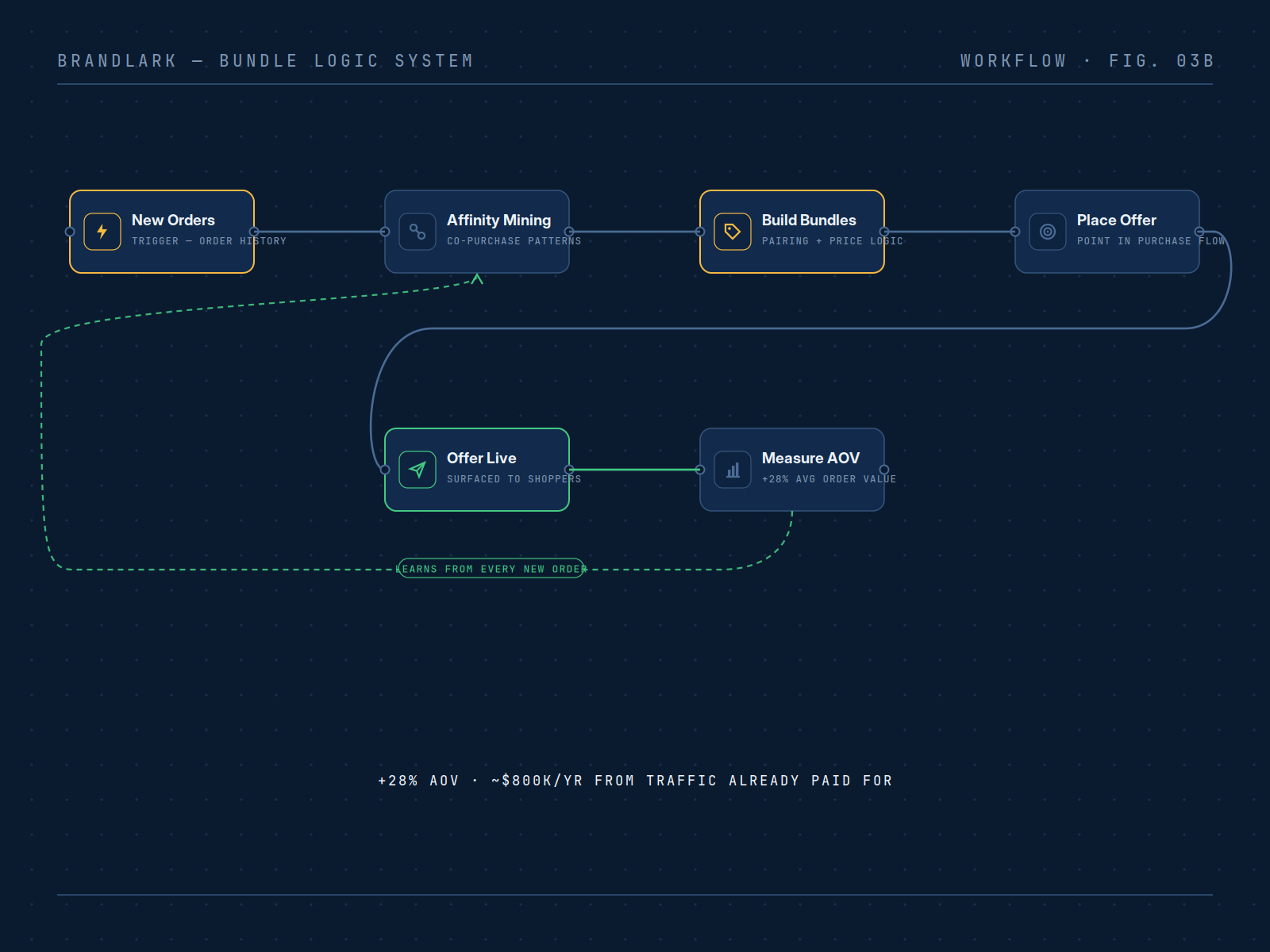
The system was built around four components: a purchase affinity map, a tiered bundle engine with margin constraints, on-page bundle surfacing at the product and cart level, and a post-purchase trigger sequence for bundle completion.
Component 1: Purchase Affinity Mapping
We analyzed 18 months of order history across all 200+ SKUs to map which products customers actually buy together. Cookware had the strongest signal: customers buying a skillet purchased a compatible lid 38% of the time when surfaced together — and only 9% when not. Categories with low natural affinity were excluded to avoid creating noise that reduces conversion.

Component 2: Tiered Bundle Engine with Margin Constraints
The bundle engine applies tiered discounts calibrated to both attach incentive and margin floor. The client set the tiers: buy 2 qualifying items and receive 10% off the bundle; buy 3 and receive 18% off. Each tier was validated against the margin profile of every eligible bundle pair — no bundle enters the system if the discount at any tier pushes what the client actually keeps below their floor of 42% gross. The engine updates automatically when the product catalog changes. New SKUs are evaluated against the affinity map and margin thresholds before entering the bundle pool. Discontinued SKUs are removed without manual intervention.

Component 3: On-Page Bundle Surfacing
The bundle offer appears in two places: the product detail page (PDP) and the cart. On the PDP, the bundle module sits below the primary add-to-cart button and above the product description. It presents the two or three highest-affinity complements with the discount tier labeled explicitly ("Add lid and handle cover — save 15%"). Social proof was added where available ("Most popular combination"). In the cart, a second bundle prompt appears for customers who have added a single eligible item — showing what complements are available and the discount they would unlock by adding one more. The cart prompt is shown once and dismissed cleanly if the customer proceeds without adding.

Component 4: Post-Purchase Bundle Completion Sequence
For customers who purchased a single high-affinity item and did not take the bundle offer at checkout, a post-purchase email sequence surfaces the complement products within 48 hours. The email references the specific item purchased ("You recently picked up the 10-inch skillet"), presents the natural complements with the bundle discount still active for 7 days, and links directly to a pre-populated cart. The client defined the discount duration. The sequence is automated — no manual campaign management required. Customers who complete the bundle through the email sequence are tagged for suppression from future bundle prompts for that product cluster to avoid redundant messaging.

Infrastructure the Client Owns
The bundle system was deployed as client infrastructure, not a managed service. The catalog team manages the affinity map as the product mix evolves, updates margin floors when cost structures change, and adds new bundle pairs without external support. The logic is documented. New team members can be onboarded to it in a single session.
Margin enforcement is automatic
Every bundle is validated against the margin floor before it enters the system. The team doesn't have to manually check whether a discount is profitable — the system won't surface an offer that violates the constraint. If a product's cost structure changes, the margin check updates automatically at the next catalog sync.
Affinity data updates with the catalog
As new products are introduced and order history accumulates, the affinity map recalibrates. A new SKU that generates strong co-purchase signals within its first 90 days will enter the bundle pool based on data, not a curator's judgment. Products that stop generating attach signals are flagged for review.
No platform dependency
The system operates independently of the ecommerce platform's built-in upsell tools, which typically surface recommendations based on collaborative filtering without margin awareness or structured discount logic. Platform-native tools don't know the client's margin floor. The bundle system does.
The Impact
Within six weeks of deployment, the bundle attach rate across eligible product pages reached 22%. Average order value moved from $67 to $86 — a 28% increase. Revenue per session increased 31% without any change to traffic volume, paid spend, or the primary conversion funnel. The system captured incremental revenue from customers who were already in the purchase session and would have otherwise checked out with a single item.
| Before | With Bundle System | |
|---|---|---|
| Average order value | $67 | $86 (+28%) |
| Single-item order rate | 74% | 52% (22pt reduction) |
| Bundle attach rate | ~3% (manual, untargeted) | 22% (system-driven) |
| Revenue per session | Baseline | +31% |
| Margin on bundled orders | Not tracked | Enforced above 42% floor |
| Time to identify bundle opportunities | Manual, ad hoc | Automated affinity map |
| Bundle management overhead | Curatorial, ~4 hrs/week | Catalog sync, ~30 min/week |
| Post-purchase bundle capture | None | 48-hr email sequence, 7-day offer window |
The Compounding Value of AOV Improvement
A $19 AOV increase on 35,000 annual orders generates $665,000 in incremental revenue — without acquiring a single additional customer. The customer acquisition cost stays the same. The return on that cost improves because each acquired customer now generates more revenue per transaction. For a brand spending $180K/year on paid acquisition, a 28% AOV lift effectively reduces blended CAC by the same proportion — compounding the return on every dollar already being spent.
The bundle system is one component of how Brandlark builds Yield Expansion for ecommerce brands: extracting more revenue from existing traffic and existing customers by closing the gap between what customers are willing to spend and what the purchase experience allows them to spend. For this home goods client, the $800K projected incremental annual revenue required no increase in media spend, no new channels, and no changes to the primary product pages.
A bundle system that lifts AOV by 28% doesn't just improve a single metric. It changes the unit economics of the entire acquisition program. When each customer generates more revenue per session, the threshold for profitable acquisition lowers, the ceiling for allowable CAC rises, and the brand can compete more aggressively in paid channels where it was previously constrained by margin.
We use Growth Capital Efficiency (GCE) to determine which yield levers get prioritized and in what sequence. For this client, bundle logic ranked above PDP redesign and mobile CVR optimization in initial GCE analysis because the affinity data confirmed the attach opportunity was real, the margin profile supported a meaningful discount, and the implementation timeline was short relative to expected return. It was the highest-certainty yield initiative available.